
Foundation Series: Policy Governance
How organizations translate legal requirements into actionable processes that manage risk and foster transparency.

What is Policy Governance and why is it important?
Strong policy governance is the backbone of any well-managed organization, especially in highly regulated industries such as financial services. In Financial Services Organizations (FSOs), almost every aspect of risk management - from credit exposure and liquidity buffers to cybersecurity and third-party oversight - is codified through a structured hierarchy of Governance Documents (Framework, Policy, Standard, and Procedure). These documents translate the complex web of external obligations into actionable internal requirements that can be understood, implemented, and monitored across the line of defense.
U.S. regulators such as the Office of the Comptroller of the Currency (OCC), the Federal Reserve (“Fed”), and the Federal Deposit Insurance Corporation (FDIC) all emphasize the importance of policy governance that clearly define requirements and roles and responsibilities:
“While the board or a designated board committee is responsible for approving designated policies, management is responsible for developing and implementing the policies. The CEO and management should periodically review policies for effectiveness. Policies should control the types of risks that arise from the bank’s current and planned activities. To be effective, policies should clearly delineate accountability and be communicated throughout the bank.”
In practice, this means that banks rely on a layered governance structure, each with a specific purpose. Laws, rules, and regulations set external requirements, whilst internally, the Risk Governance Framework, policies, and standards define minimum requirements and roles and responsibilities. Procedures, processes, and controls then bring those requirements to life, ensuring consistency, accountability across business lines, and a robust internal control environment. Understanding how these documents are designed, how they interconnect, and where they are in the lifecycle, is key to appreciating how modern risk management operates within FSOs.
Governance Document Stakeholders
Policy owners, authors, and approving authorities each play distinct yet interconnected roles in ensuring strong policy governance. While additional roles may exist, these three represent the essential minimum for an effective governance framework:
Governance Document Owner
Usually a senior leader (e.g., Managing Director, Department Head) responsible for the Governance Document’s effectiveness and alignment with the policy governance environment.
Approves or sponsors Governance Document creation, updates, and retirement.
Ensures resources, training, and monitoring are in place for proper implementation.
Governance Document Author
Typically, a governance or risk subject matter expert (SME).
Drafts and revises the Governance Document, ensuring alignment with the policy governance environment.
Coordinates stakeholder feedback and incorporates review comments.
Approving Authorities
Serve as the formal review and approval body. This may be a Policy Governance Approval Committee or an individual such as the Head of Enterprise Risk Management (ERM) or Chief Risk Officer (CRO).
Review significant policy changes for alignment with the risk management framework, high-impact exceptions, and conflicts between documents.
Ensure alignment with enterprise strategy and risk appetite.
Send select Governance Documents to the Board of Directors (or designated committee thereof, e.g.: Risk Committee) for review and approval.
Policy Governance Environment
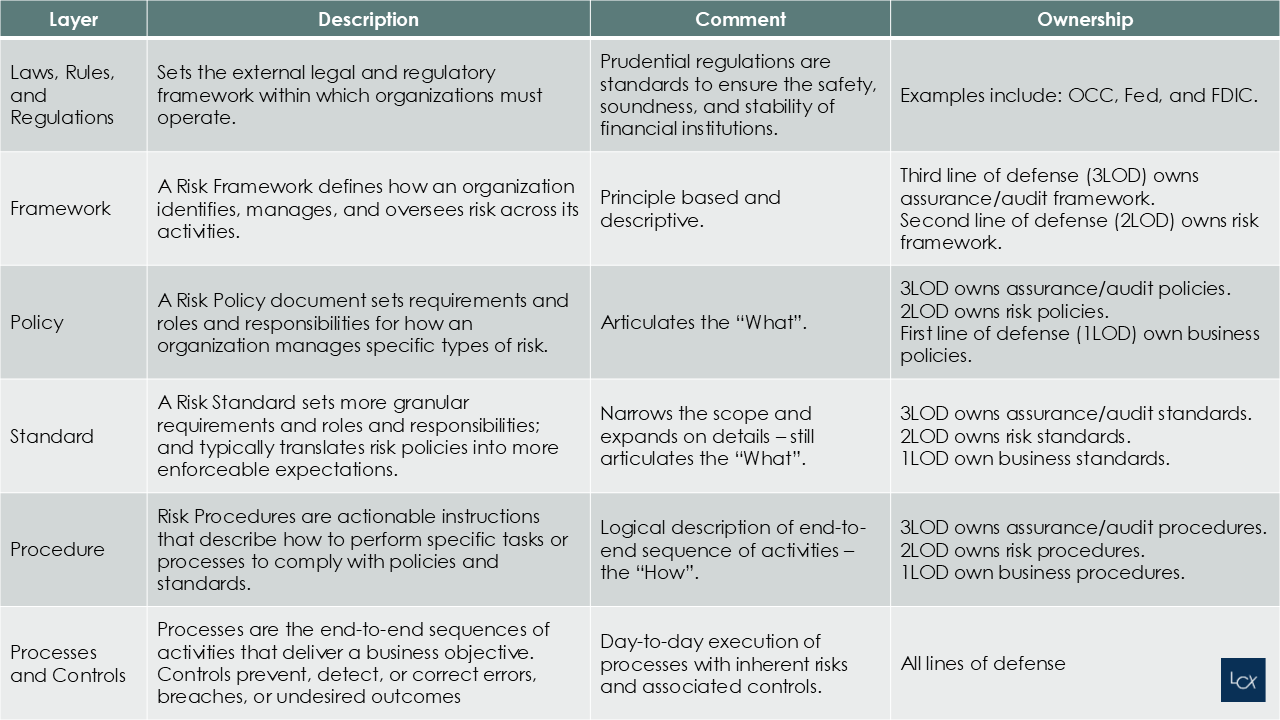
As you move down each layer (in Table 1), you move away from legalese in the Federal Register to more practical, action oriented and measurable - this is where governance becomes tangible: staff follow procedures, managers oversee controls, and auditors verify compliance.
Each Governance Document layer serves a distinct purpose. Large FSOs typically maintain all layers, while smaller FSOs may operate with fewer (e.g.: omitting a Standard), yet still be deemed appropriate. There is no prescribed number of Governance Documents that is considered “correct” - the structure should reflect the FSO’s size, complexity, and needs. That said, regulators expect to see Governance Documents addressing all key risk categories (e.g.: credit risk, operational risk, compliance risk) and major risk programs (e.g.: policy governance, risk identification, risk appetite). Ultimately, the scope and detail of these documents should align with the FSO’s business profile and the inherent risks it faces.
“The scope and detail of those policies and procedures vary depending on bank size and complexity.”
Related Document Types
In addition to formal risk Governance Documents, FSOs rely on a wide range of supporting artifacts that help bring governance to life in day-to-day operations. These include desktop procedures, Frequently Asked Questions (FAQs), templates, tools, guidance, and visual diagrams. While supporting artifacts may not be subject to the same formal governance requirements (outlined in e.g.: the Policy Governance Policy), they are essential enablers of implementation and consistency. Such artifacts translate governance requirements into practical, actionable steps that teams can easily follow. Importantly, these supporting documents can be owned by the Governance Document Author or downstream stakeholders, reflecting the unique operational nuances of each area. In summary, supporting artifacts serves as a critical bridge between enterprise-level policy intent and frontline execution.
Risk Procedure vs. Desktop Procedure
Whilst these artifacts sound similar - they are district in many ways. Please see Table 2 below:
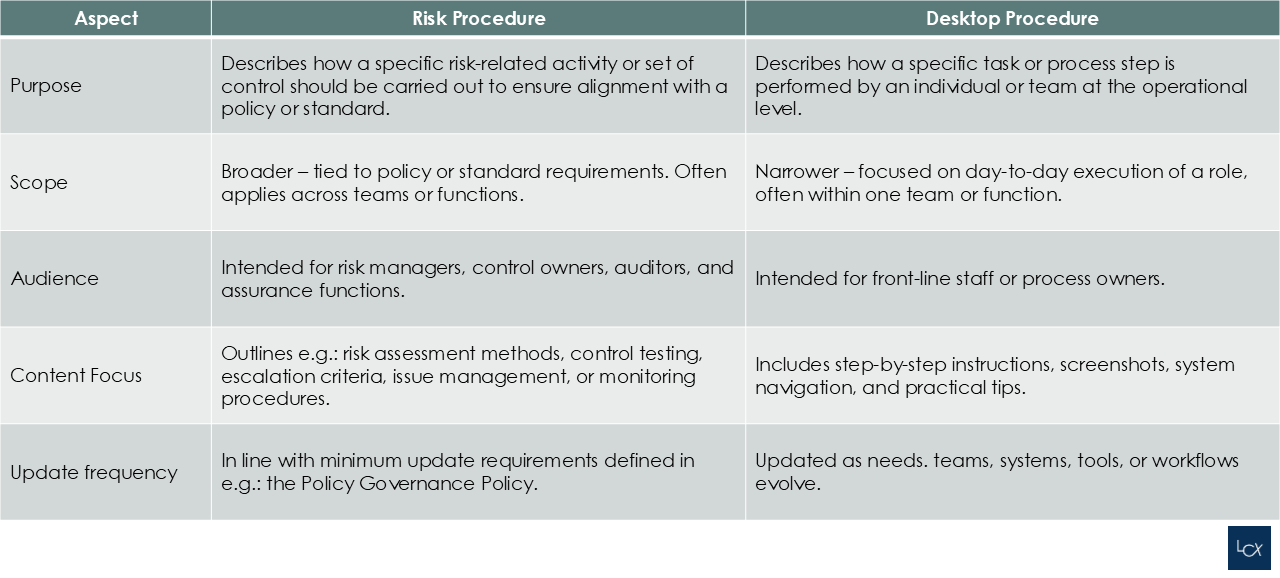
Inconsistencies often exist between organizations in how these supporting materials are defined and governed. What one FSO may classify as e.g.: a Desktop Procedure, another might label e.g.: a Standard Operating Procedure (SOP), reflecting variations in terminology, ownership, and formality. This diversity underscores the need for clear governance principles and shared understanding to maintain coherence across the broader policy governance environment.
Traceability through the Policy Governance Environment
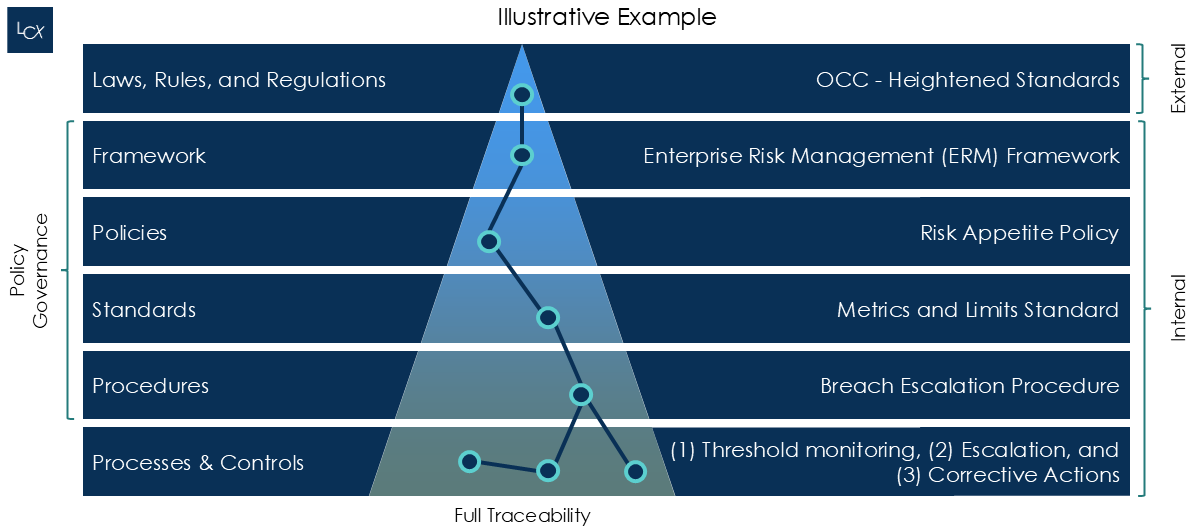
A mature policy governance environment will enforce a parent–child relationship, creating a traceable hierarchy that links all the layers together. This structure forms a comprehensive sets of inventories, where each layer aligns with and supports the one above (below) it. Having this end-to-end visibility - from regulation to control - is invaluable for effective change management. When a regulation, policy, or standard changes, the organization can immediately identify which upstream and downstream documents and processes are affected, ensuring timely updates and continued compliance. Please see Figure 1 below as an example.
The Role of Governance, Risk, and Compliance (GRC) Tools
GRC tools play a critical role in strengthening an organization’s policy governance environment. These digital platforms provide a centralized repository for governance documents, version control, and approval workflows, ensuring that stakeholders access the most current and authoritative information. Beyond document management, effective GRC tools integrate all the layers described above in a traceable and auditable manner. This transparency improves oversight, simplifies regulatory reporting, and supports continuous monitoring. When implemented effectively, GRC tools not only enhance efficiency and reduce manual effort, but also embed governance into daily operations, helping FSOs turn compliance from a reactive activity into a proactive routine.
Policy Governance Design
Next, let us consider Policy Governance design principles. I will admit that this is more of an art than science.
Keep things simple and clear.
Consider your audience - think about your business stakeholders in the front line who may not be risk SMEs.
Avoid jargon, spell out acronyms, and define key terms.
List related Governance Documents to help users connect the dots to relevant and adjacent risk routines and practices.
While it is important to maintain linkages between documents, duplication should be minimized - reference existing materials rather than repeat them. This also makes change management easier.
Each Governance Document should be able to stand on its own, so that end users can easily understand it without piecing together multiple documents.
A well-written introductory section should clearly state the Governance Documents’ purpose, context, and how it helps manage risk.
Every requirement should be explicitly tied to defined roles and responsibilities, ensuring accountability and clarity in execution.
Clearly identify the Governance Document’s Owner, Author, and Approving Authority, version, and approval / renewal and effective dates.
Clearly state exception management processes, in line with e.g.: the Policy Governance Policy and key points of contact.
Tagging Governance Documents to the FSO’s Risk Taxonomy
Each governance document should serve a defined purpose within the overall policy governance environment, minimizing overlapping and duplication. To strengthen connectivity and traceability, governance documents should be tagged to the organization’s risk taxonomy, linking them directly to relevant risk categories. This alignment helps ensure that policies and standards not only articulate requirements, but also clearly demonstrate how they mitigate specific risks within the enterprise. This approach can also help flesh out any governance gaps by taking a holistic view of all relevant risk taxonomy nodes.
For policy governance purposes, it may be helpful to consider a cross-cutting taxonomy category, as some Governance Documents are agnostic (e.g.: Risk Appetite Policy) and do not manage only one risk category.
Governance Document Templates
Using standardized templates and naming conventions promote consistency in structure, tone, and presentation, improving usability and reinforcing a common language of governance. Together, these practices create a more transparent, integrated, and risk-informed policy environment that supports consistent interpretation and execution across all lines of defense.
Many of the policy concepts discussed here have been translated into modular policy templates, available in the Polisight Store for practitioners who need something immediately usable.
Managing the Governance Document Lifecycle
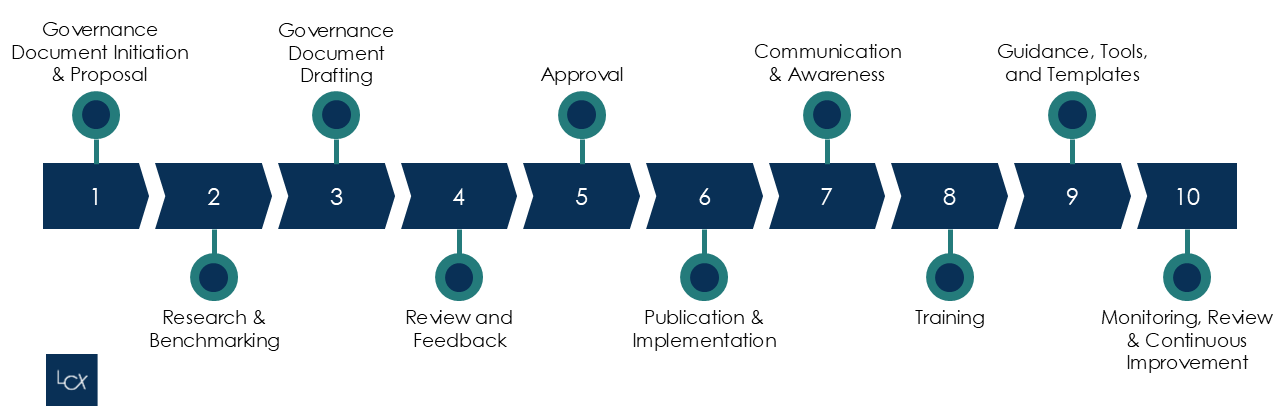
Effective management of the Governance Document Lifecycle is essential to maintaining the integrity, relevance, and usability of the FSO’s risk management environment. Governance Document are not static artifacts - they must evolve with regulatory expectations, business strategy, technology, and emerging risks. Without structured lifecycle management, FSOs risk operating on outdated or conflicting requirements, leading to gaps in compliance and inconsistency in execution. A disciplined lifecycle approach ensures that documents are reviewed, refreshed, and retired in a timely manner, with clear accountability for ownership and oversight. It also provides a transparent record of change, supporting auditability and reinforcing trust in the FSO’s policy governance. Please see figure 2 below.
To be effective, policy governance must balance rigor with practicality. The strongest policy environments operate under a centralized governance model, where document development, approval, and publication follow clearly defined requirements and roles and responsibilities. Each Governance Document should have an accountable policy owner and approving authority commensurate with the seniority of the Governance Document. Equally important, policies should be supported by strong communication, training, and implementation planning, ensuring that expectations are not only written but understood and applied. Finally, periodic reviews and independent assurance activities help confirm that policies remain effective, relevant, and aligned to the FSO’s strategic objectives and evolving risk landscape.
Steps in the Governance Document Lifecycle (reference Figure 2)
Governance Document Initiation & Proposal
Identify the need for a new Governance Document or revision (e.g., regulatory change, audit finding, operational gap, or strategic initiative).
Draft a Governance Document Proposal summarizing the purpose, scope, rationale, and expected outcomes.
Obtain initial sponsorship or approval from the Governance Document Owner.
Research & Benchmarking
Review laws, rules, and regulations that apply (partnering with Compliance and Legal as needed).
Benchmark industry practices and internal standards.
Consult subject matter experts (SMEs), business, and risk functions, and in some cases external consultants (as appropriate).
Governance Document Drafting
Develop the Governance Document using the FSO’s applicable template.
Review & Feedback
Circulate the draft to key stakeholders for feedback as early as possible. Engagement is crucial.
Confirm alignment with existing Governance Document.
Iteratively enhance the Governance Document.
Governance Approval
Submit to the appropriate approving authority - including the Board of Directors (or designated committee thereof, e.g.: Risk Committee) for review and approval.
Obtain formal sign-off and record it in the policy repository or GRC tool.
Publication & Implementation
Publish the Governance Document on the designated internal platform (e.g., intranet or GRC tool).
Communication and Awareness
Develop and execute a communication plan.
Announce the policy launch (email, newsletter, town hall) - ideally a combination of all.
Target communications to affected stakeholder groups.
Highlight key changes and impacts.
Include executive messaging to reinforce importance and accountability.
Training
Develop or update training materials (e-learning, workshops, FAQs).
Deliver targeted training to relevant teams or roles.
Track training completion.
Guidance, Tools, and Templates
Provide supporting materials, such as:
Job aids, templates, FAQs.
Process maps or flowcharts.
Points of Contact (POCs) for policy queries.
Integrate Governance Document requirements into tools and systems.
Monitoring, Review & Continuous Improvement
Define metrics and controls to monitor policy adherence.
Conduct periodic reviews (in line with e.g.: Policy Governance Policy).
Capture/reference relevant data such as risk events, issues, lessons learned, feedback, and incidents to inform future updates.
Maintain an audit trail of all versions, approvals, and communications.
Governance Document Retirement
Retiring governance documents is an essential part of a healthy policy lifecycle and ties directly to the final step of the publication process (step 10): monitoring, review, and continuous improvement. Just as policies are carefully drafted, approved, and communicated, they must also be periodically assessed for continued relevance and effectiveness. When a policy or related document becomes obsolete - due to e.g.: regulatory change, system upgrades, or process redesign - it should be formally retired to prevent confusion, duplication, and noncompliance. The retirement process goes through the same governance approval as new or revised documents (see step 5), ensures outdated documents are removed from official repositories (step 6), stakeholders are notified (step 7), and any replacement artifacts are properly referenced - including training (step 8) and guidance, tools, and templates (step 9).
Governance Document Exceptions Management
In real life, exception management is a practical way for organizations to remain both compliant and flexible. While policies are designed to set clear, consistent requirements, real-world situations sometimes demand temporary or narrowly scoped deviations e.g.: when a system limitation prevents full compliance or when urgent business needs require an alternative approach. Effective exception management ensures these deviations are formally requested, risk-assessed, and approved by the appropriate authority (e.g.: Governance Document Owner or Approving Authority). Each exception is documented with clear rationale, compensating controls, and an expiry or review date. This process not only helps maintain accountability and transparency but also provides valuable insights into whether a policy remains fit for purpose or needs revision.
Conclusion
Policy governance is more than paperwork - it is a structured system that connects external obligations to internal operations. By understanding the hierarchy of Governance Documents and managing their lifecycle effectively, FSOs can ensure that laws and regulations are translated into practical, risk-aware processes. Done well, policy governance strengthens accountability, reduces risk, and enables consistent, effective operations across the enterprise.
If you are looking for practical templates and governance resources, you can find them in the Polisight Store.